
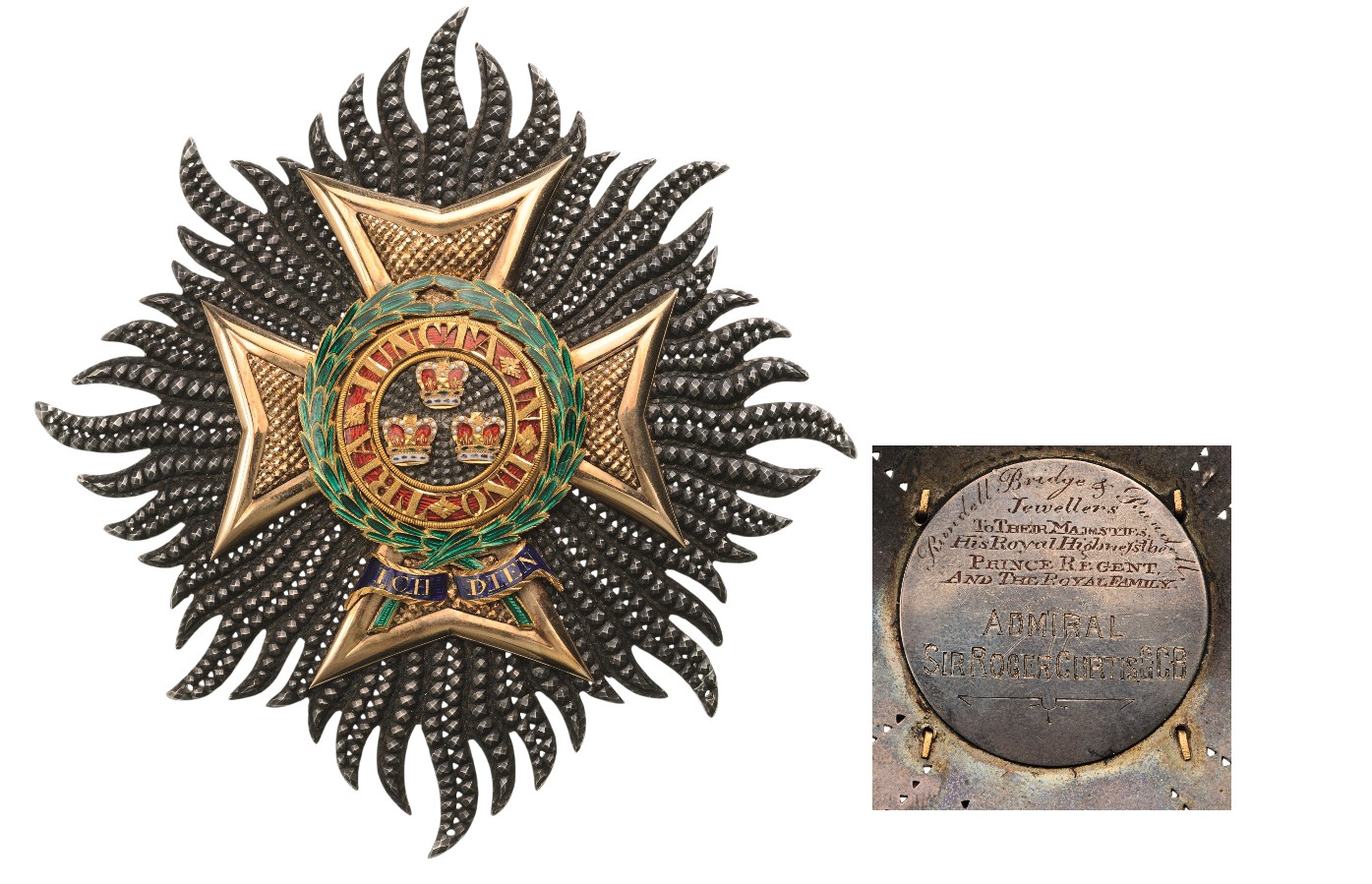
The Highly Important and Historically relevant, Unique Grand Cross Breast Star (Military Division) belonged to the Admiral Sir Roger Curtis: chiseled and pierced silver rays with flame-curved ends; the centre made in the form of a golden cross with chiseled fields and convex, polished borders; the centre with three royal crowns on chiseled silver field, within a red enameled outer circlet with applied motto “TRIA JUNCTA IN UNA” made of engraved gold, this, surrounded by a laurel wreath also made of gold, enriched by bright, emerald-green, translucent enamel; below, a deep-sea-blue enameled gold scroll with the motto “ICH DIEN” in gold lettering; plain reverse, never fitted with a pin, but with round piercings drilled to the extremities of the major rays to allow the fastening of the star to the habit; centre, round escutcheon with engraved maker’s mark “rundell Bridge & rundell. Jewellers TO THEIR MAJESTIES HIS ROYAL HIGHNESS THE PRINCE REGENT, AND THE ROYAL FAMILY.” And below “ADMIRAL SIR ROGER CURTIS GCB”.
An insignia of one of the earliest Grand Crosses in the Military Division, extremely fine condition and retaining a beautiful patina; to the lot, a photo of the admiral’s portrait is also attached.
Sir Roger Curtis (June 4th 1746 November 14th 1816) was an Officer in the British navy, who saw action in several battles during his long, extensive career, especially during the American War of Independence, distinguishing himself at the Great Siege of Gibraltar and during the French Revolutionary Wars. His career had a sudden fall, because of his later criticized conduct in the later stages of the battle of June 1st 1794 between the British and the French fleet, when Curtis at a crucial stage of the battle took the command, when the old Admiral Lord Howe felt himself too tired to direct the operations. In any case, Curtis acted bravely, despite the confused situation and his errors in not pursuing the defeated, French Fleet. His acting conducted to general distrust in his commanding abilities, thus, he was later relegated to shore commands (Cape Town, from 1800 to 1803, when he was promoted to full Admiral), then in Britain, where he acted well in the Naval commissions, with his last post as Commander-in-Chief, Portsmouth, where he presided controversial courts martial, being even accused of partiality, in favour or against judged officers. He retired in 1810. In 1815 he was created Knight Grand Cross of the Order of the Bath (London Gazette Nr. 17003 April 15th, 1815).
Horatio Nelson, who knew him well and served with him in the Mediterranean, described Sir Roger as “an able officer and a conciliating man”. Dim.: 105,0x107,0 mm. I RR!